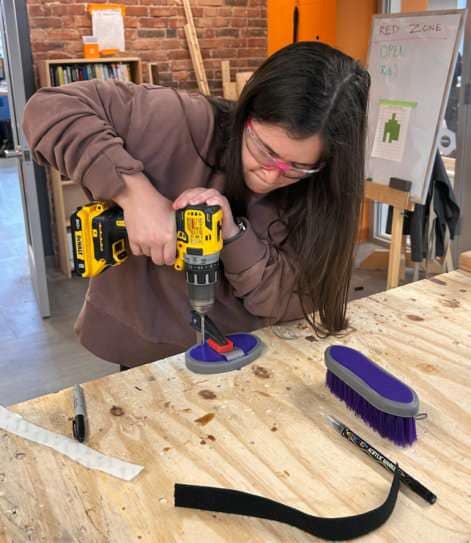

Maya Croissant is a first-year occupational therapy student at MGH Institute of Health Professions. She participated in the 2026 Intercollegiate AT Hackathon and wrote the following article about it.
Boston pulses as a hub for math, science, and healthcare, where innovation isn’t just happening, it’s leading the way. The Intercollegiate Assistive Technology Hackathon (IATH) unites these disciplines into a one-week design experience where students and community designers collaborate to create assistive tech solutions.
This event is sponsored by Cecropia Strong and supported by Tufts University and MGH Institute of Health Professions (MGH IHP) faculty. This year, 10 interprofessional teams designed and executed assistive solutions.
Team E
Our team, Team E, consisted of 4 students: first-year occupational therapy student (OTD/s) Maya Croissant (MGH IHP), second-year OTD/s Lauren Lowe (Tufts), master’s student in Innovation & Management and Biomedical Engineering Shayna Kantor (Tufts), and undergraduate Human Factors Engineering student Karissa Chan (Tufts). Our team was under the guidance of Assistant Professor Kevin Berner (MGH IHP).
This year, our four-student team partnered with Ellorie Levy. Ellorie is an occupational therapist who conducts client sessions at Easterseals Bridge Center (a year-round indoor/outdoor recreation and equine center that specializes in accessible programming for individuals with disabilities).
Ellorie’s pitch for the Hackathon was focused on adaptive grooming equipment for her clients to use with more independence. The client who sparked Ellorie’s idea, Aubrie, had difficulty grasping the combs needed for horse grooming. Aubrie’s strength was limited, so they needed hand-over-hand assistance to complete the brushing motion. Through collaboration with Team E, Ellorie wanted to improve Aubrie’s independence by finding an adaptive solution for clients with limited hand function.
The Process
First, we met with Ellorie to discuss specific details about the device we can help create. Ultimately, we decided to focus on stabilizing the wrist and somehow attach it to the brush, so the brushing motion would be coming from shoulder or elbow movement. She gave us some of Aubrie’s limitations, such as her wrist and elbow mobility range, but wanted the device to be adaptable to other clients.
Next, we brainstormed ways to attach straps and stabilizers onto the brush so no grip strength would be required to groom the horses.

We first considered creating a cast, or a 3D printed stabilizer that would keep Aubrie’s wrist in a neutral position. This idea had some advantages, considering if the cast ever broke, a new one could be reprinted using the same 3D design.
However, this option would not be transferrable across multiple clients. Since Ellorie wanted a more universal design, a splint is not a one-size-fits-all solution. To improve adaptability, we then steered towards removing the brush handles altogether, instead directly attaching the brush to the wrist.
This approach allowed the brush itself to act as both the stabilizer and grooming tool while so the client could rely more on gross motor movements to brush the horse. We decided to utilize adjustable Velcro straps on the head of the brush to ensure cross-client adaptability.

After finalizing our design plan, we got to work. During the weekend, we got together at the Tufts Nolop, a creative makerspace for students. After taking apart the brushes, we attached Velcro straps to the body of the brush in two to three locations: one strap that goes around the palm of the hand, a strap over the forearm, and an optional middle strap for the longer brush. We also made sure to add foam padding for user comfort!
The Solution
With our design, we were able to create a simple solution so that Ellorie’s clients can use horse grooming tools with limited hand strength. Our final product emphasizes the client’s gross-motor skills to complete the brushing motion, reducing the need for fine motor grip strength. Since this device has adjustable Velcro straps, it can also be placed anywhere on the arm, depending on the need or preference of the client (for example, on the dorsal or palmar side of the wrist).

At the end of the week-long hackathon, our team presented our designs to a panel of judges. Each of the 10 teams gave an overview on their proposed assistive tech problem, their week-long collaborative process, and their final result. Teams in our cohort addressed a wide range of challenges, from adaptive cleaning techniques to weatherproof gear protection. While our team did not receive an award, three teams were recognized with “Most Innovative,” “Most Collaborative,” and “Most Functional.”

Conclusion
Our team enjoyed getting to work together for this project. We were given the opportunity to collaborate across disciplines and campuses while working toward a shared goal of human-centered design. Working in interprofessional teams allows creativity to thrive because each person brought a unique skill set and perspective to the table.
This experience demonstrated how collaboration across healthcare and design fields can lead to practical and adaptable solutions that support client success!


